SEO & Performance
Answer Engine Optimization: How to Get Cited by ChatGPT and Perplexity
How to structure content, schema and authority so ChatGPT, Perplexity and Google AI Overviews quote your site.

When someone searches for a service near them, Google answers with a map and three local results before any normal listing. Getting into that map pack is the difference between a full calendar and a quiet phone.
Local SEO is its own discipline with its own ranking factors. The good news for small businesses is that the biggest levers are ones you control directly: your Google Business Profile, your reviews and the consistency of your details across the web.
To rank in local search in 2026, complete and actively manage your Google Business Profile, earn a steady stream of recent reviews, keep your name, address and phone number consistent everywhere, and publish location-relevant pages. Google Business Profile signals carry roughly a third of local ranking weight, and proximity to the searcher is the single biggest factor.
Google weighs three things for local results: relevance to the search, distance from the searcher and the prominence of the business. In practice those break down into a handful of signal groups.
Proximity sits underneath all of it. In Whitespark’s 2026 survey, distance to the searcher accounted for roughly 55 percent of ranking decisions, which is why results change as you move down the street. You cannot move your premises, but you can win on every other signal.
Because the profile carries roughly a third of local ranking weight, completeness is the highest-return work you can do. Fill every field, choose the most accurate primary category, then add relevant secondary categories.
Keep it active. Add real photos, post updates, list your products and services, answer questions and keep your hours correct, including holidays. An active, complete profile signals trust to Google faster than almost anything else.
Reviews are about 16 percent of local ranking weight, and the algorithm reads more than the star average. Quantity, velocity, recency and sentiment all count. A competitor earning ten fresh reviews a month will often outrank a business sitting on two hundred reviews from three years ago.
Ask every happy customer at the moment the value is obvious, make the link one tap, and reply to every review, positive or negative. A steady drip beats an occasional flood.
A citation is any mention of your name, address and phone number across the web. In 2026, consistency matters far more than volume. A few accurate listings on authoritative directories outperform hundreds of scattered, conflicting ones.
Audit the major directories, fix any mismatched addresses or old phone numbers, and remove duplicate listings. As AI tools increasingly pull business facts from these sources, accurate citations have become a trust layer rather than a dying tactic.
Your website still has to back the profile. Build a clear page for each service and, if you serve several areas, a genuine page for each location rather than thin duplicates. Add LocalBusiness schema, embed a map, and include your address in the footer.
Write for how people actually search, including near-me and town-level phrasing, and link these pages together so Google understands your service area and depth.
Proximity to the searcher is the single largest factor, accounting for roughly 55 percent of local ranking decisions in 2026. After that, your Google Business Profile carries the most weight at around a third, followed by on-page content and reviews.
There is no fixed number. Google weighs recency and velocity as much as total count, so a steady stream of fresh reviews matters more than a large but stale pile. Aim for a consistent monthly flow and reply to each one.
Yes, but consistency beats volume. A handful of accurate listings on authoritative directories outperform mass submissions, and AI tools that pull business facts from these sources have made accuracy more valuable, not less.
Profile and review improvements can shift the map pack within a few weeks, while citation cleanup and content build authority over two to three months. Treat it as ongoing maintenance rather than a one-time project.

How to structure content, schema and authority so ChatGPT, Perplexity and Google AI Overviews quote your site.

Sitemaps, structured data, redirects and the settings that keep Google happy as your site grows.
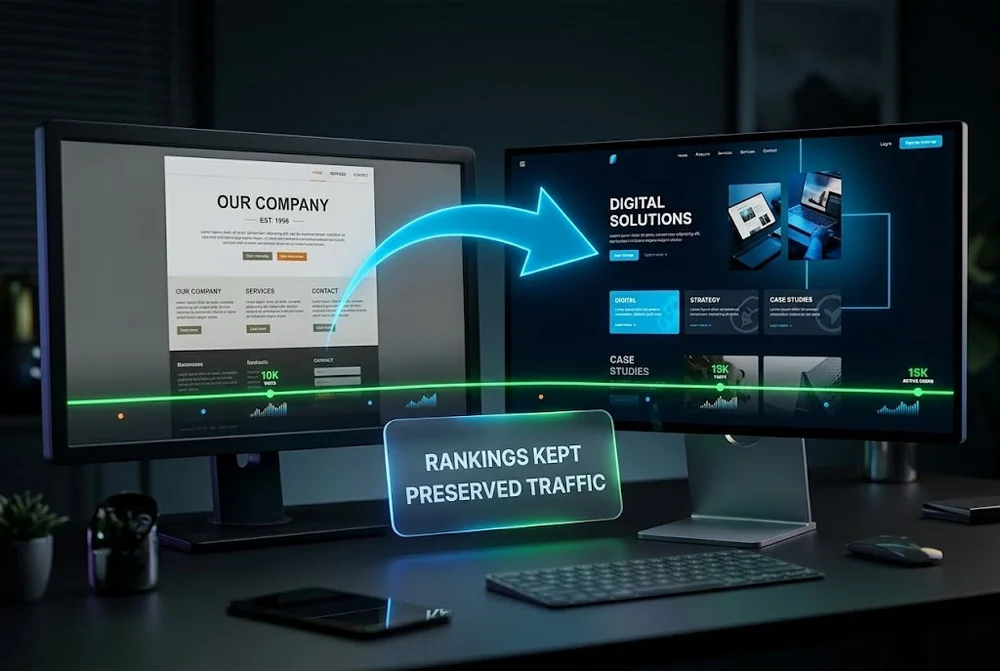
Inventory URLs, map 301 redirects and preserve content so a redesign keeps your rankings.
From first sketch to launch day, we design sites that look unforgettable and convert like they mean it.